31 August 2026
Stop Patching Industrial Roofs That Have Already Failed
Industry opinion
Local repairs are sensible when defects are local. They become a false economy when the roof is failing as a system and the client is buying the same problem repeatedly.
A repair is valuable when it changes the roof trajectory. A patch that only moves the next leak is maintenance theatre.
Direct answer
Industrial roof patching should stop being the default where defects are widespread, leaks recur in different locations, corrosion is progressing, rooflights and gutters are also failing, repairs cannot be warranted or access costs repeatedly exceed the value of the work. At that point, the client needs a condition led comparison of targeted refurbishment, overcladding and replacement.
Repair is not the enemy
There is a lazy argument in roofing that every old roof should be replaced. That is no more credible than claiming every roof can be saved with another tube of sealant. Local repair is often the correct commercial decision where the defect is isolated, the surrounding system is sound and the client needs to preserve a roof with useful life remaining.
The problem is not repair. The problem is repeating low confidence repairs after the evidence already shows the roof is failing across multiple components.
The signals that patching has reached its limit
- Water ingress returns after several unrelated repairs.
- New leaks are appearing in different roof zones.
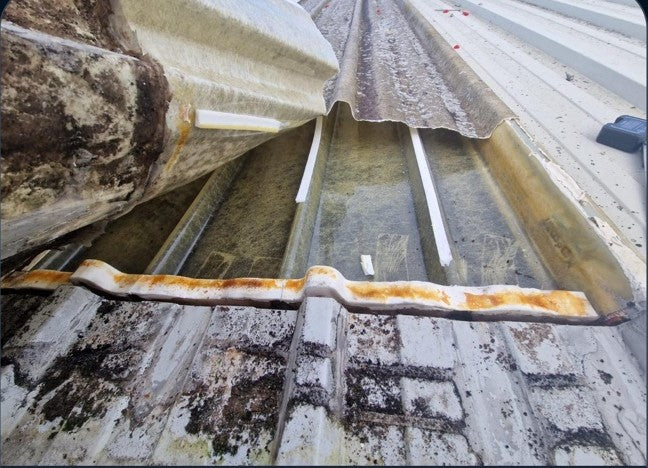
- Cut edge corrosion, failed laps, fixings and rooflights are widespread rather than local.
- Gutters and outlets are deteriorating at the same time as the roof covering.
- Previous coatings or sealants are debonding, cracking or hiding the original substrate.
- Each repair requires expensive scaffold, MEWP or internal protection.
- The contractor cannot give a meaningful warranty because the surrounding roof is beyond control.
- The client has no condition plan and reacts only when water enters the building.
Why repeated patches feel cheaper
A £3,000 repair is easier to approve than a £150,000 refurbishment. The comparison looks obvious until the client adds five years of emergency callouts, access, damaged stock, internal making good, disrupted production and management time. Even then, the accounting often hides the true cost across separate maintenance budgets.
The repair budget looks small because the consequences are being paid somewhere else.
The useful question is not “repair or replace?”
Commercial roofs rarely offer only two choices. The real options may include targeted sheet replacement, cut edge treatment, gutter lining, rooflight renewal, liquid waterproofing, coating, overcladding, phased replacement or complete re roofing. The correct comparison should consider remaining life, disruption, warranty, future solar, lease obligations and the building plan.
| Roof condition | Likely route | Why |
|---|---|---|
| Isolated defect with sound surrounding roof | Targeted repair | Restores performance without unnecessary capital work |
| Several connected defects but viable substrate | Planned refurbishment | Treats the roof as a system and extends useful life |
| Suitable structure with operational constraints | Consider overcladding | May improve weathering and thermal performance with less removal |
| Widespread failure, wet build up or poor structure | Replacement or major intervention | Local work cannot create a reliable long term asset |
| Insufficient evidence | Professional survey and opening up | The client should not choose a system before the condition is known |
Phasing is better than pretending
A client may not have the budget for full replacement this year. That does not justify describing another patch as a permanent solution. A better plan may contain urgent containment, high priority refurbishment and a phased capital programme with clear triggers.
Honesty about service life helps the client budget. It also allows access and temporary works to be planned across more than one defect, reducing the cost of repeatedly returning to the same roof.
What we would tell a client
If the evidence supports a local repair, carry it out properly and record it. If the roof is failing across the covering, rooflights, gutters and interfaces, stop buying isolated reactions. Commission a condition led plan and decide what useful life the building actually needs.
Related TCR insight
Browse buyer guidance, technical project lessons and construction market analysis from TCR.
Explore all commercial roofing insightsRelevant TCR services
Frequently asked questions
How many repairs are too many?
There is no fixed number. The pattern, extent, recurring access cost, surrounding condition and required service life matter more than the count.
Can a failing industrial roof be refurbished instead of replaced?
Often, yes, where the substrate, structure and interfaces can support a credible system. A survey is needed to define the route.
Are roof coatings a permanent solution?
A coating can be a valid refurbishment system on a suitable, prepared roof. It is not a substitute for dealing with unsuitable substrates, wet insulation or major structural defects.
Can TCR prepare a phased roof plan?
Yes. A survey can separate urgent containment, high priority work and planned capital options so the client can budget in stages.
Are repeated roof repairs no longer solving the problem?
Send the repair history, photographs and affected roof areas. TCR can review whether the defect is local or whether the roof is failing as a connected system.
Review the roof condition