31 August 2026
Three Contractors Said Replace the Structure. We Saved the Client More Than £100,000
Project insight
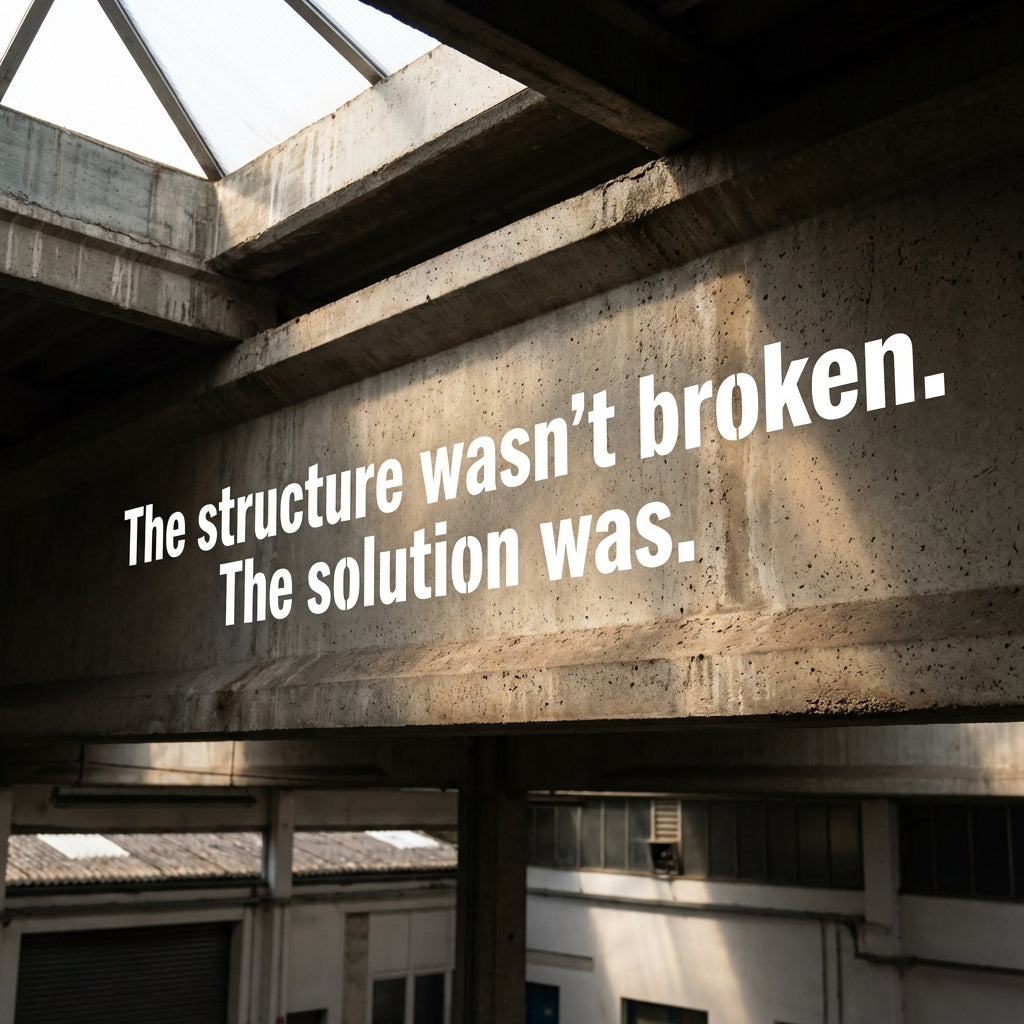
Three contractors recommended structural replacement. TCR challenged the assumption, retained the sound concrete purlins and saved the client more than £100,000.
The most expensive part of a proposed roofing solution is sometimes an assumption. Before replacing a sound structure, prove that replacement is technically necessary.
Direct answer
A concrete purlin roof can sometimes be refurbished without drilling through or replacing the existing purlins. The correct route depends on the purlin condition, structural assessment, wind loading, roof build up and an approved fixing design. On one TCR project, challenging the original assumption reduced the projected cost by around £132,000 while the client remained operational.
Project evidence: challenge the assumption before changing the structure
On an anonymised manufacturing project, three earlier recommendations treated structural intervention as unavoidable. TCR separated the roofing requirement from the assumption about how the new system had to be supported.
The figures reflect the project information available at the time. They are evidence of the decision process, not a rate or benchmark for another building.
The recommendation everyone had accepted
The client came to us after speaking with three contractors. Each had reached the same conclusion: the existing concrete purlins had to be altered or replaced before the roof could be upgraded. The likely cost had moved beyond the roofing works and into major structural intervention.
That recommendation sounded decisive, but it was built on an untested assumption. The purlins were being treated as the obstacle because the proposed roof system was expected to fix through them. Nobody had first asked whether the new roof could be supported in a different way.
The question was not “How do we drill the concrete purlins?” It was “Why are we assuming we need to drill them at all?”
Why drilling prestressed concrete is not a casual detail
Prestressed concrete purlins are not ordinary blocks of concrete. Their performance depends on internal reinforcement and prestressing forces. Drilling, cutting or loading them without a properly assessed design can introduce risks that are out of proportion to what looks like a small fixing operation.
That does not mean an existing purlin can never be drilled or adapted. It means a roofing contractor should not make that decision from a rate sheet, a photograph or a generic fixing detail. The purlin condition, reinforcement arrangement, fixing zone, pull out requirement and overall structural load path all need to be understood.
The route we developed
Instead of treating the concrete purlins as the point of attachment, we explored a non penetrative support arrangement that worked around the existing structure. The concept was developed into a project specific solution using recognised components and a defensible load path rather than improvised site fixings.
The practical attraction was obvious. Retaining the sound structure avoided unnecessary demolition, reduced programme risk and kept the facility functioning. The technical requirement was equally clear: the alternative still had to satisfy wind loading, restraint, weathering, compatibility and installation quality.
- Condition first: establish whether the concrete purlins are actually sound and suitable to retain.
- Design second: confirm how the new roof loads and wind forces will be transferred.
- Approved components: use a system detail that can be evidenced, inspected and repeated.
- Interfaces: coordinate eaves, ridges, rooflights, gutters and penetrations rather than solving only the main sheet area.
- Handover: retain calculations, technical data, photographs and inspection records for the client file.
The commercial result
The structural replacement route had been priced at roughly £200,000. The developed roofing solution was approximately £68,000 on the figures available at the time. That produced a saving of around £132,000 before the wider operational and programme benefits were counted.
The saving was not created by reducing safety, specification or evidence. It came from removing work that could not be justified. This distinction matters. Value engineering is not the same as making a specification cheaper. Proper value engineering removes unnecessary cost while protecting the required performance.
| Route | Likely consequence | Commercial effect |
|---|---|---|
| Wholesale structural intervention | Major enabling works, disruption and a longer programme | Highest capital cost and greater delivery risk |
| Unassessed direct drilling | Potential structural and warranty uncertainty | A cheaper quote with unacceptable unresolved risk |
| Project specific non penetrative solution | Retained sound structure with designed restraint | Substantially lower cost and reduced disruption |
When retaining the structure would be the wrong answer
Opinionated content still needs an honest boundary. We would not argue for retention where the concrete is materially damaged, reinforcement is compromised, design information is inadequate, loading cannot be verified or the proposed system cannot be supported by an acceptable technical detail.
There are projects where replacement is the correct answer. The point is that replacement should follow evidence, not habit. A client should be able to see why the structure cannot be retained, what alternative routes were considered and which assumptions drive the cost.
What clients should ask before accepting structural replacement
- What evidence shows the existing purlins are unsuitable to retain?
- Has a structural engineer reviewed the proposed drilling, fixing or additional load?
- Has the roof system manufacturer accepted the proposed detail?
- Can the new roof be supported without penetrating the existing concrete?
- What part of the cost is roofing and what part is structural enabling work?
- What inspection and handover evidence will prove the installed solution matches the design?
Those questions do not guarantee a cheaper project. They do make it much harder for an untested assumption to become a six figure instruction.
Related TCR insight
Browse buyer guidance, technical project lessons and construction market analysis from TCR.
Explore all commercial roofing insightsRelevant TCR services
Frequently asked questions
Can every concrete purlin roof be refurbished without drilling?
No. The answer depends on the existing structure, roof geometry, load requirements and available approved details. A site specific assessment is required.
Is a non penetrative route automatically safer?
No solution is automatically safe. It must be designed, installed, inspected and evidenced. The advantage is that it may avoid unnecessary alteration of prestressed concrete.
Why can structural replacement quotes vary so much?
Quotes may include different assumptions about demolition, temporary works, access, waste, design responsibility, internal protection and programme constraints. A defined scope is essential.
Can TCR review a proposed concrete purlin refurbishment?
Yes. TCR can review the available drawings, photographs, surveys and proposed system, then identify the information needed before a buildable route can be confirmed.
Client confidentiality: Based on an anonymised TCR client project. The client name, building name and identifying project details have been removed.
Have you been told the roof structure must be replaced?
Send TCR the survey, proposed scope, drawings and photographs. We can review the roofing assumptions, identify the information still needed and confirm whether a survey or technical scope review is the right next step.
Request a technical scope review