31 August 2026
The Leak Is Not Always Where the Water Appears
Project insight
Water follows laps, profiles, insulation, frames and internal finishes. The stain is evidence of arrival, not proof of the entry point.
The first visible stain tells you where water finished its journey. It does not necessarily tell you where that journey began.
Direct answer
Commercial roof leaks can appear far from the external defect because water travels along sheets, membranes, insulation, purlins, curtain wall frames, services and internal finishes. A reliable investigation should compare internal evidence with roof and façade conditions, drainage, weather exposure and defect patterns, then state the likely routes and any further testing required.
Project evidence: the investigation found several plausible water routes
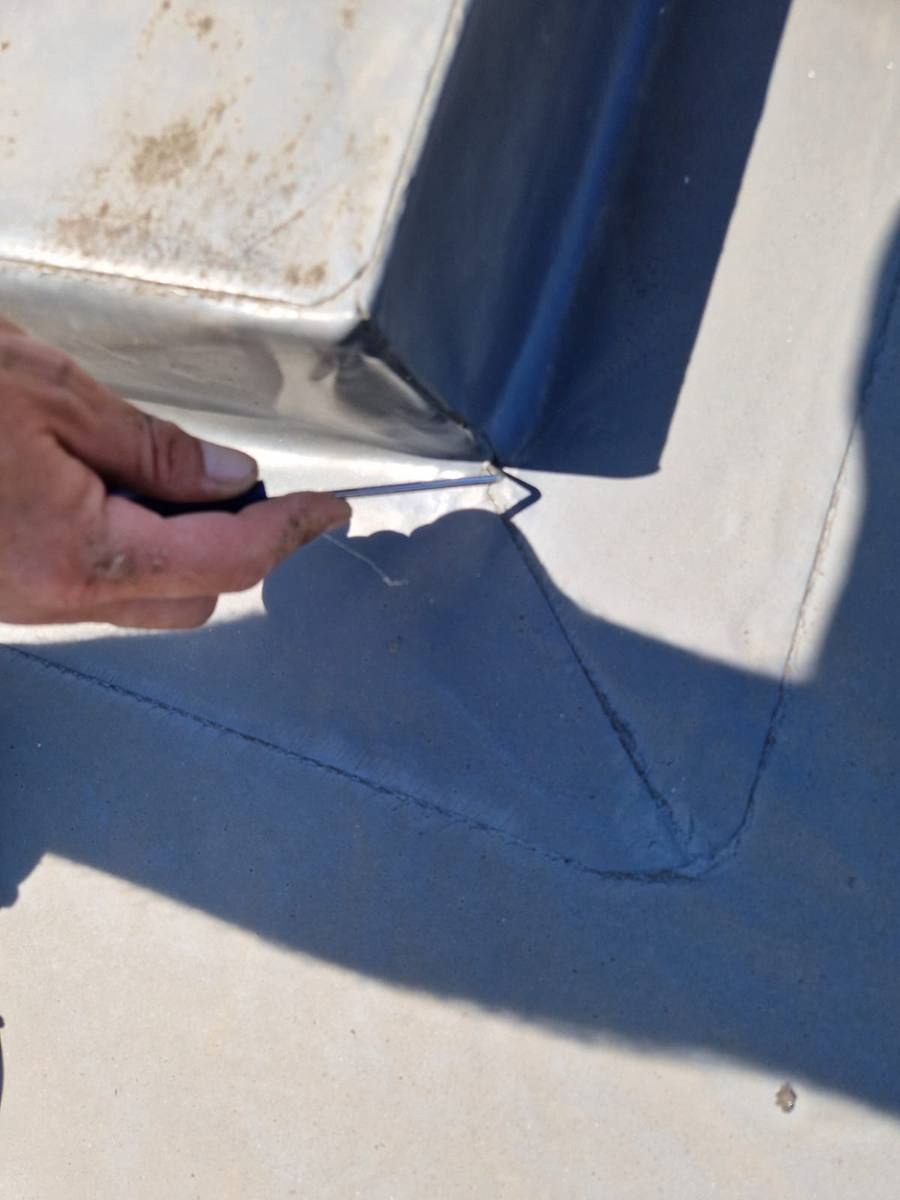
On an anonymised commercial facility, the inspection recorded defects across roofing, cappings, fillers, fixings, membrane details, drainage and curtain-wall interfaces. The internal symptom could not responsibly be reduced to one bead of sealant.


The purpose of the survey was to distinguish confirmed defects, likely ingress routes, limitations and areas needing further investigation.
One building, several plausible routes
At an anonymised life sciences facility, water ingress was reported around a stairwell and occupied areas. The inspection did not reveal one neat hole waiting to be sealed. It found failed curtain wall seals, poor metal roof patches, short cappings, deteriorated fillers, open laps, missing fixings, local single ply defects and obstructed plant room drainage.
Any one of those defects could matter. Several could combine. The survey therefore had to do more than photograph the nearest external mark. It had to organise the evidence into likely routes and priorities.
Why water travels
- Profiled sheets can carry water along side laps, end laps or underside condensation paths.
- Insulation and liners can spread moisture before it becomes visible.
- Curtain wall pressure plates, gaskets and cappings can direct water around frames.
- Service penetrations and upstands can release water into concealed zones.
- Blocked outlets can create ponding and expose details that remain dry in normal rainfall.
- Wind driven rain can enter at a different elevation from the internal symptom.
The investigation sequence matters
- Record the internal symptom, timing, weather direction and history.
- Map the external roof and façade areas that could plausibly feed that location.
- Inspect drainage, laps, penetrations, cappings, rooflights and adjacent wall interfaces.
- Distinguish active openings from old staining or previous repairs.
- Prioritise obvious urgent defects and identify where testing or opening up is needed.
- Issue a written conclusion that separates confirmed defects, likely routes and unresolved possibilities.
Why repeated sealant repairs fail
Sealant is useful when it is part of the correct detail on a suitable, prepared substrate. It is not a diagnosis. Repeatedly adding sealant around the internal location of a leak can hide evidence, contaminate surfaces and postpone the real investigation.
A repair should follow a reasoned defect hypothesis. Otherwise the client is buying another experiment without being told it is an experiment.
What the report should say
| Report statement | What it means for the client |
|---|---|
| Confirmed visible defect | The defect exists and requires action, although causation may still need testing |
| Likely ingress route | The observed conditions support a reasoned route from exterior to interior |
| Inspection limitation | Access, finishes or weather prevented a complete conclusion |
| Further investigation | Water testing, opening up, moisture testing or specialist input is required |
| Priority action | Urgent containment, high priority repair or planned capital work is recommended |
The value of a combined condition and leak survey
A leak can be the symptom that brings the client to the roof, but the wider condition determines whether a local repair is sensible. On this project, the survey separated urgent outlet and open detail work from higher priority envelope repairs and a planned replacement design for another roof area.
That gave the client a route rather than one undifferentiated quotation. Immediate risk could be controlled while the larger building decisions were planned.
Why water can travel so far from the defect
Commercial roof build ups contain laps, liner trays, insulation, purlins, ducts, cable routes and internal finishes. Once water enters, gravity is only one influence. Wind pressure, capillary action and the profile of the materials can move it sideways before it finally becomes visible. A stain beneath one bay can therefore originate at a rooflight, ridge, penetration or cladding junction some distance away.
That is why a credible investigation records both the internal symptom and the external drainage path. It should distinguish observed facts from likely causes, identify what could not be inspected and explain how the proposed test or repair will prove the diagnosis. Repeatedly sealing the nearest visible joint is not investigation; it is a wager with the client’s maintenance budget.
Related TCR insight
Browse buyer guidance, technical project lessons and construction market analysis from TCR.
Explore all commercial roofing insightsRelevant TCR services
Frequently asked questions
Can a visual survey prove the exact leak source?
Sometimes, but not always. A visual inspection can identify strong evidence and likely routes. Testing or opening up may be needed for confirmation.
Should roof and cladding be inspected together?
Where water could enter through façade interfaces, cappings, gutters or curtain walling, the building envelope should be considered as one system.
Why do leaks only appear in certain wind directions?
Wind driven rain changes the pressure and route of water at laps, joints and elevations. Weather history can be important evidence.
Can TCR provide a written leak investigation report?
Yes. TCR combines condition reporting and leak investigation during the same professional survey, subject to access and agreed scope.
Client confidentiality: Based on an anonymised TCR survey. The client and facility are not identified.
Still repairing the same commercial roof leak?
Send photographs of the internal damage and roof areas, previous repair records and the site postcode. TCR can confirm whether a combined condition and leak-detection survey is the right route.
Arrange a leak investigation