31 August 2026
The Best Time to Make an Industrial Roof Solar Ready Is Before the Panels Arrive
Future buildings
A solar installation can last longer than the roof beneath it. The roof, access and warranty strategy should be settled before the PV design is frozen.
Installing twenty five years of solar equipment on a roof with five years of reliable life is not decarbonisation. It is a future removal and reinstatement bill.
Direct answer
Before commercial solar PV is installed, the roof should be assessed for condition, remaining service life, structural capacity, drainage, waterproofing interfaces, safe access, fire and insurer requirements, warranty compatibility and the cost of future roof work beneath the array. Where replacement or major refurbishment is foreseeable, it is usually better to coordinate that work first.
Solar changes the roof from a covering into a platform
A commercial roof without solar mainly has to manage weather, movement, drainage, access and the building environment. Add PV and it must also support equipment, maintenance traffic, cabling, penetrations or ballast, fire strategy requirements and a long term relationship between two different warranty systems.
The energy case may be excellent. The sequencing can still be wrong.
The remaining life mismatch
Solar projects are commonly evaluated over long operating periods. If the roof is already approaching major refurbishment, the client may later pay to isolate, remove, store and reinstall the array simply to reach the waterproofing beneath it.
The roof does not become younger because the solar business case is attractive.
What a solar readiness review should examine
- Current roof condition and credible remaining service life.
- Structural capacity for the proposed system, access and snow or wind effects.
- Existing water ingress, corrosion, wet insulation and fragile rooflights.
- Gutter and outlet access after panels, walkways and cable routes are installed.
- Fixing or ballast interfaces and responsibility for waterproofing details.
- Roof and PV warranty compatibility, inspection and notification requirements.
- Fire strategy, emergency access and insurer expectations.
- How future maintenance, roof repair or replacement can be carried out safely.
A large industrial re roof gave the right opportunity
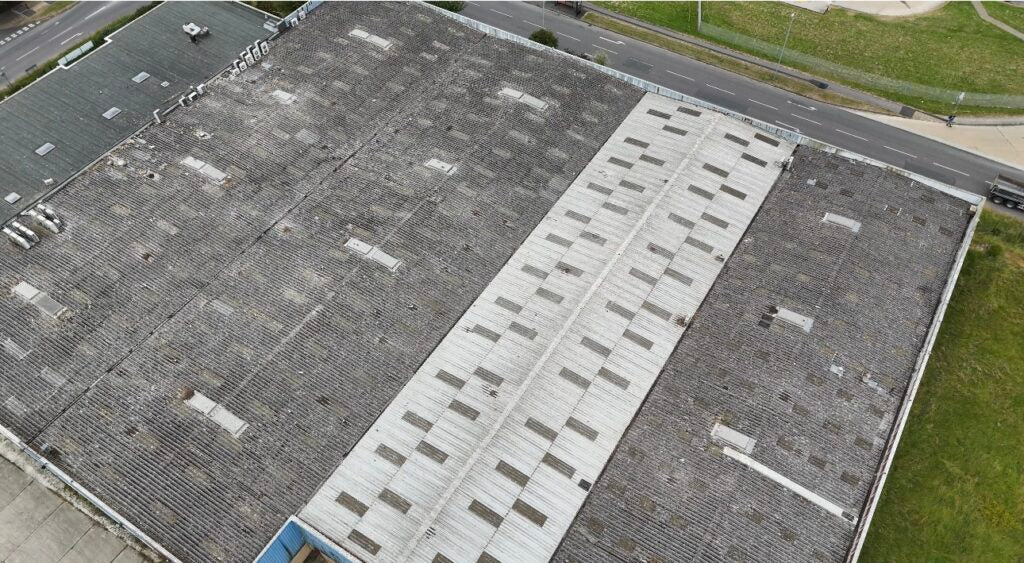
On an anonymised industrial project ahead of a new tenancy, the existing asbestos cement roof was removed and a modern replacement system installed with formal inspection, certification and a long term system warranty. Future photovoltaic compatibility was considered as part of the roof decision rather than left for a later contractor to solve.
That sequencing gave the client a documented roof asset with a known build up, known performance and a clearer route for future solar. It also avoided fixing a major energy installation above a roof already due for replacement.
Solar can expose weak roof decisions
| Existing condition | PV risk | Better route |
|---|---|---|
| Active leaks or wet insulation | Defects become harder and more expensive to access | Investigate and repair or refurbish first |
| Widespread corrosion | Fixings and access may disturb a declining roof | Condition survey and lifecycle comparison |
| Fragile fibre cement and rooflights | Installation and maintenance require significant fall protection | Plan replacement, overclad or permanent access controls |
| Poor drainage access | Panels or walkways obstruct gutters and outlets | Redesign layout and maintenance zones |
| Short remaining warranty or unclear ownership | Roof and PV providers may dispute responsibility | Agree interfaces and warranty protocol before contract |
Public sector solar makes roof readiness more important, not less
Government backed programmes have targeted rooftop solar across around 200 schools and around 200 NHS sites. That is a major opportunity, but public buildings also contain ageing roofs, complex estates, occupied environments and limited maintenance budgets. The rush to install generation should not create a second programme to remove it for overdue roof work.
The best solar project is not the one that installs panels fastest. It is the one that allows the building, roof and energy system to perform together for the planned life.
Related TCR insight
Browse buyer guidance, technical project lessons and construction market analysis from TCR.
Explore all commercial roofing insightsRelevant TCR services
Frequently asked questions
Does every commercial roof need replacing before solar?
No. A sound roof with sufficient remaining life and compatible details may be suitable. The decision should follow condition and structural review.
Can solar be installed on an overclad roof?
Often, but the roof system, spacer arrangement, loads, fixing method, warranty and maintenance access must be coordinated.
Who is responsible if a solar fixing leaks?
Responsibility should be defined between the roofing contractor, PV contractor, designer, system manufacturer and client before installation.
What information should a roof survey provide to the PV designer?
Roof build up, condition, remaining life, structural information, fragile areas, drainage, access, penetrations, warranties and recommended repair or replacement work.
Official sources and further reading
Client confidentiality: The industrial re roof example is anonymised. The client and building are not identified.
Planning solar on an existing commercial roof?
TCR can review roof condition, remaining life, drainage, fragile areas, access and foreseeable refurbishment before the PV design is finalised.
Arrange a solar-readiness roof review